
Written by: Gloria Kosir
Summer legal placements are instrumental in students’ professional journeys. Experiential learning develops legal judgment, deepens students’ understanding of the law in practice, and shapes their professional identity ahead of graduation.
Externships can also offer the opportunity to contribute to a meaningful purpose through legal work. Two Iowa Law students spent their summers giving back to their country through legal externships in the military justice system. Through their experiences, they grew professionally and felt a strong sense of service.
Michael Coles, 27JD
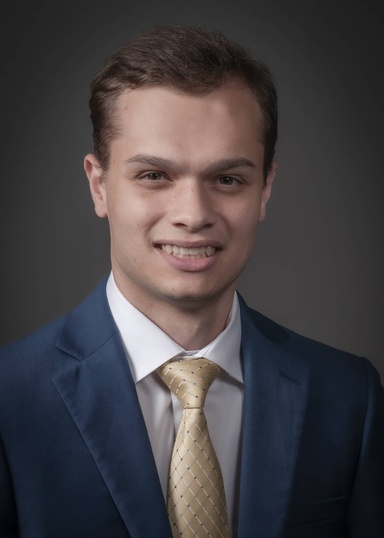
Michael Coles (27JD) spent the summer after his 2L year as an intern for the U.S. Army Judge Advocate General’s (JAG) Corps. The JAG Corps is the legal and military justice branch of the United States Armed Forces and serves many functions, including providing personal legal assistance to service members and their families. Coles worked with the Office of Special Trial Counsel, which is responsible for the independent prosecution of serious felonies under the Uniform Code of Military Justice (UCMJ).
Coles is a First Lieutenant in the Army Reserve and was interested in expanding his service. He was able to connect with a judge advocate during an on-campus interview, which eventually led him to his summer in Fort Bragg, North Carolina.
Coles found working with the JAG Corps a rewarding experience that allowed him to dive deep into hands-on legal work. As an intern, he was heavily involved in legal research and writing. He noted that when working in public interest, it’s important to be able to collaborate with staff of other state and federal agencies.
“The internship combines the practice of law with military protocol,” Coles said. He was able to contrast his experience in the JAG with his 1L summer internship with RSH Legal in Cedar Rapids.
“It’s good to have an understanding of what goes on in the civilian world and what goes on in the military world,” Coles shared. “The military brings its own unique challenges and experiences that vary quite differently from civilian life.”
Coles’ JAG experience had many elements that civilian summer interns likely don’t see. He participated in mock court-martials in front of two military judges and was even scheduled to jump out of an airplane with the U.S. Army Parachute Team.
“I think the JAG internship is a great way to solidify if you want to practice law in the military as a whole or be involved in the federal side of practicing criminal law. There are a lot of connections with JAG and federal law,” Coles said.
At its core, Coles’ internship meant more than an opportunity to practice law; it was also a chance to contribute to the nation.
“I wanted to explore a new way to contribute to a mission bigger than myself,” Coles said. He participated in the internship in his civilian capacity, separate from his role as a reservist.
Ryan Renger, 28JD
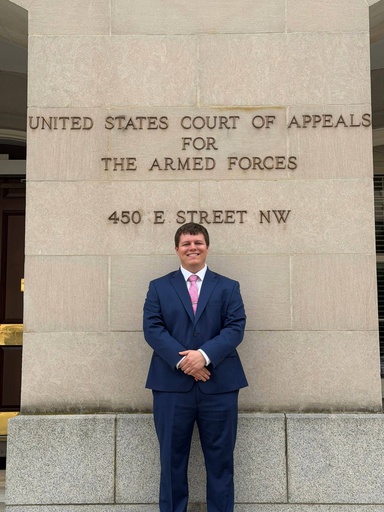
Ryan Renger (28JD) was a judicial intern for the U.S. Court of Appeals for the Armed Forces the summer after his 1L year. The Court exercises appellate jurisdiction over members of the armed forces around the world and is composed of five civilian judges appointed by the president for 15-year terms.
Renger met the judge whom he interned for at the 2026 American Bar Association (ABA) Midyear Meeting’s Judicial Clerkship Program. Iowa Law sponsored Renger and five other students to participate in the program, and after learning about the Court and the judge’s background, he emailed them to look for externship opportunities.
“The Court is really unique. It’s a federal appellate court that has such a specified area (military justice), which I’ve never done before,” Renger said. “That alone was basically learning a whole new set of laws and regulations, which felt like an interesting challenge I wanted to take up.”
Renger was very involved throughout his internship. His capstone project was writing a bench memo for a case for the Court's current term and presenting his recommendations to the judge in chambers. Other tasks included briefing petitions for review, reading opinions, performing legal research, and checking legal citations.
“I essentially got to act like a mini clerk, which was such a valuable experience. [I was doing] actual substantive work that had an actual impact on chambers,” Renger said. As the only intern in a team of six, Renger had the opportunity to learn from a judge and clerks with decades of combined experience.
Renger will spend the summer after his 2L year with the Sacramento County District Attorney's Office, applying his research and writing skills from this summer to a new duty in his hometown.
“I like government work, and I like the idea of helping the public,” Renger said. “This internship was one of those movie moments where you didn’t think this would ever be what you do.” Renger hopes to build on the skills he learned through this experience throughout his time at Iowa Law and his career.