
Written by: Blake Etringer
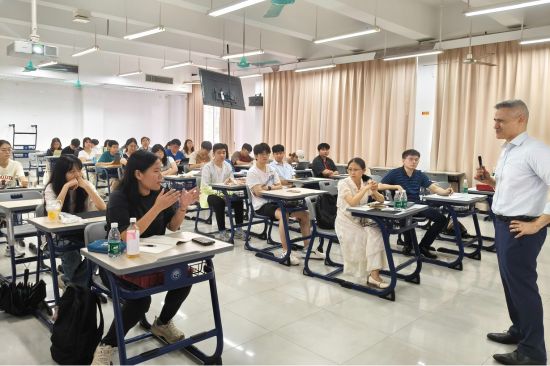
César Rosado-Marzán, the Edward L. Carmody Professor of Law and director of graduate programs and visiting scholars, had a unique opportunity to share his legal research and expertise over 7,500 miles away from the Boyd Law Building.
While on an academic visit to China, Rosado-Marzán was invited to speak at Guangdong University of Foreign Studies, one of China’s leading institutions for law and international studies. The visit was made possible largely thanks to Professor Honghua Liu, a visiting scholar at the Iowa College of Law.
Guangdong Province, which is home to the major industrial cities of Guangzhou, Shenzhen, and Dongguan, is one of the most important manufacturing hubs in the world. For a scholar of labor and employment law like Rosado, the region offered a rich context in which to examine the issues of global trade, labor systems, and worker rights.
Despite contemporary tensions between China and the United States, Rosado-Marzán encountered an atmosphere of collaboration, with many faculty and students willing to discuss their shared challenges and evolving labor dynamics.
“What struck me most during my time there was the palpable enthusiasm for academic exchange with the United States,” Rosado-Marzán said. “Despite the current geopolitical headwinds, faculty and students alike expressed a strong desire to sustain and deepen educational collaboration. Many were eager to discuss how such partnerships might endure and evolve.”
In June, Rosado-Marzán delivered two presentations at Guangdong University of Foreign Studies. In the first, he shared an overview of his book project, A Baseline of Decency: Social Capital, Symbolic Capital, and the Moral Economy of Alt-Labor and Worker Centers. Later that day, he gave a lecture on U.S. federalism.
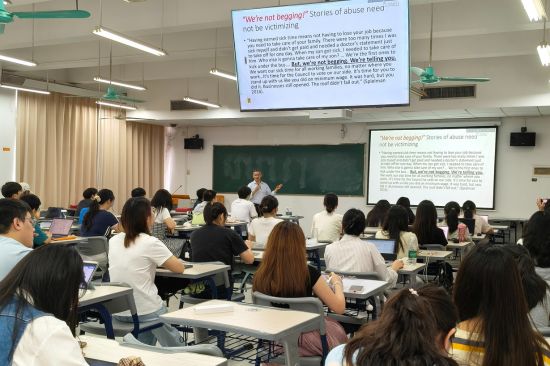
Both sessions attracted unexpectedly large audiences, requiring organizers to move to larger lecture halls. Faculty members and students alike were impressively well-prepared and initiated dynamic discussions with Rosado-Marzán at both sessions.
“They demonstrated a nuanced understanding of the distinction between ‘law on the books’ and ‘law in action,’ and posed thoughtful questions about the practical efficacy of U.S. labor law—often drawing comparisons with their own experiences in China,” Rosado-Marzán said.
The following day, Rosado-Marzán delivered a second lecture on U.S. federalism at nearby Dongguan University of Technology. There, too, he found students and faculty eager to discuss comparative legal issues and labor regulation frameworks.
Throughout his time in China, Rosado-Marzán engaged in rich discussions with fellow scholars about his ongoing research on worker centers and wage theft—an issue of growing concern in both the United States and China.
“Their insights into parallel challenges within the Chinese labor system were illuminating, and we explored potential avenues for comparative research,” Rosado-Marzán said. “One particularly promising outcome is the possibility of launching a joint project with a faculty member there focused on wage theft across both jurisdictions.”
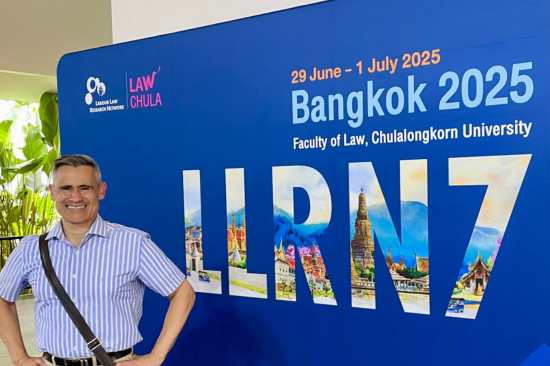
Following his time in China, Rosado-Marzán traveled to Thailand to participate in the Labor Law Research Network’s seventh biennial conference (LLRN7), hosted by Chulalongkorn University in Bangkok. As a member of the LLRN Steering Committee, Rosado-Marzán helped organize the global gathering, which drew over 200 labor law scholars from around the world.
On June 29, Rosado-Marzán presented a paper titled, From the Margins to the Citadel: How Domestic Workers Can Help Reimagine the Law of Work in the U.S.A. The presentation, like the conference itself, initiated vibrant discussions and diverse perspectives on the future of work and labor regulation around the world.
Throughout his travels, Rosado-Marzán found the academic exchange professionally enriching and personally inspiring. His experiences in China and Thailand reaffirmed the global relevance of his work and the enduring value of international dialogue in the field of labor and employment law.
“Beyond the formal sessions, I gained valuable insights from the diverse perspectives and deep wisdom of my colleagues, which will undoubtedly inform and inspire my future work.”