
Written by: Nic Arp
Over the course of their exceptional careers at the U.S. Department of Defense (DoD), two alumni—Lance Hampton (03JD) and Donald “Don” Timm (73JD)—have played game-changing roles in U.S. security. They have helped senior DoD leaders shape crucial defense policy and implement it on the ground, while receiving prestigious national medals for their distinguished service.
Don Timm (73JD): Ensuring Readiness
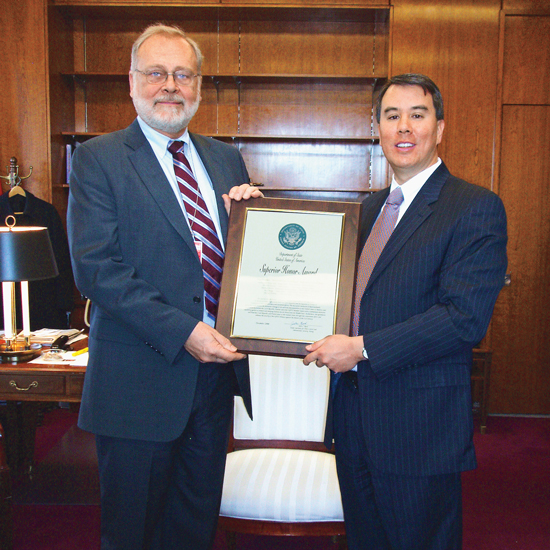
Secretary of State for Arms Control and International Security John C. Rood.
After growing up on a farm in Muscatine, Iowa, Don Timm served in the Army and worked in Germany before returning home to study law.
Timm eventually earned his undergraduate degree from Iowa State and entered Iowa Law in 1970. When he graduated in 1973, he was ranked at the top of his class and began his law career in private practice.
Noting Timm’s talent, ambition, and love of travel, a friend suggested he apply to the DoD, where he could practice international law. He did and was offered a job.
“I thought, well, I’ll try it for two years and see if I like it,” he remembered, “and I retired 37 years later.”
Timm had found his life’s work. That work was ensuring U.S. military readiness through negotiating logistical and stationing agreements with NATO allies and other nations that hosted U.S. military troops, installations, and/ or weapons systems.
“Part of it was just the routine international law issues that you get when two governments are essentially sharing one space,” Timm explained. “You’ve got to work out a modus vivendi if you’re going to make that work, and usually that involves negotiating a status-of-forces agreement or something similar that divides responsibility among the two sovereigns in certain situations.”
DoD leadership valued Timm’s expertise and ability to implement the policies they had developed. He represented the U.S. as a team member in high-stakes nation-to-nation negotiations throughout Europe and parts of Asia and Africa. He was in Europe when the Berlin Wall fell in 1989, which led to an unprecedented and complex geopolitical chess game.
Throughout his 37-year career, Timm negotiated vital agreements that enabled U.S. troops’ deployment, support, and access to weapons systems abroad.
“When I retired,” Timm said, “my organization looked at my records and told me that I had participated in or led negotiations at the government-to-government or ministry level with over 40 nations. Most of the negotiations were cross-cultural, so I had to learn about the background culture and negotiating style of my counterparts if the negotiations were to succeed. The attitudes and approach of the various nations I sat across the table from were often quite different, and the challenge provided quite a learning experience.”
He authored chapters for The Oxford Handbook of the Law of Visiting Forces and served on a NATO arbitration panel.
A crowning achievement for Timm came in 2009 when John C. Rood, then the under secretary of state for arms control and international security, presented him with a prestigious honor. The farm kid from rural Iowa had earned America’s Superior Honor Award for extraordinary performance, innovative and creative service, and commitment to our national security.
Lance Hampton (03JD): Strategizing for resilience
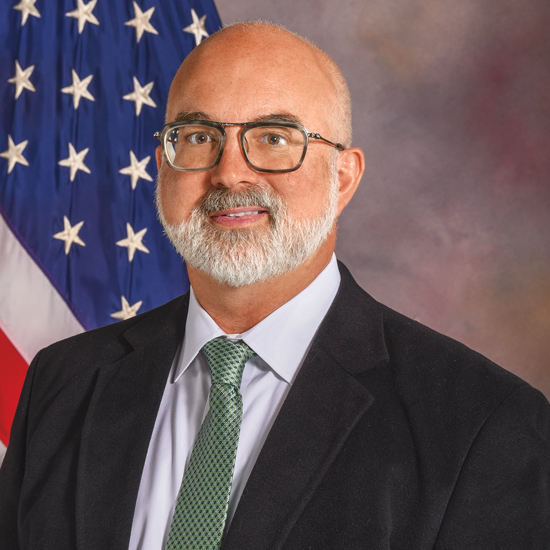
While Iowa Law was only one stop along Lance Hampton’s educational path, it has been essential to his work as a senior policy analyst at the Pentagon.
“Iowa gave me the skills to go toe to toe with any lawyer in the Department of Defense,” he said.
That’s saying something, given that Hampton has had many roles in the Office of the Under Secretary of Defense (OUSD) for Policy, most recently as senior advisor on risk management and the defense industrial base. He is often in the room when major U.S. military strategic policies are developed.
For instance, as director of strategy for OUSD (policy), he was a key player in the development and rollout of the 2022 National Defense Strategy, helping to shape and define the concept of “integrated deterrence” that is central to the document.
“I spend a lot of my time explaining the law, interpreting the law, offering alternative interpretations, and translating complex legal advice from DoD lawyers to political leadership,” he explained. “Sometimes it works the other way, where I’m affecting the legal reasoning that the lawyers use by raising practicalities from the viewpoint of a policy practitioner.”
Hampton is currently on special detail as a visiting professor at the National Defense University, teaching future policymakers about the complex relationships between America’s industrial base and its military.
He and his students tackle crucial questions about the nation’s resilience in wartime. If the U.S. homeland was attacked, what would it take to withstand the immediate damage and disruption? Does the U.S. have the ability to surge its military capacity in order to fight back? How can the government best incentivize domestic manufacturers, tech companies, universities, and trade schools to research, develop, and build the knowledge and materials vital to military success? Hampton believes the answers to ensuring strategic resilience lie in America’s tradition of dynamic, decentralized centers of innovation working together.
“These problems are so big and complicated, it’s going to take all of us,” he said. Except for two summers in an Iowa Law study-abroad program, Hampton has never been a practicing attorney (though he did pass the Iowa bar), nor has he served in the military.
He joined the DoD in 2008 as a presidential management fellow, having earned a PhD in national security and public policy from the University of Pittsburgh School of Public and International Affairs after his 2003 graduation from Iowa Law.
Hampton has since served multiple roles at DoD, including managing international agreements for the Global Defense Posture team and managing support to the FBI on the Domestic Counter-Terrorism and Global Anti-Terrorism team. As executive secretary for the under secretary of defense for policy, he focused on fostering interagency cooperation. His expertise and impact have been recognized with distinction—earning the Exceptional Civilian Service Medal (the highest-level career medal for civilians in the DoD) and the Joint Civilian Service Achievement Medal.
He also holds advanced degrees in religion and Jewish studies and continues to conduct original historical research.
Hampton considers his education from Iowa Law foundational to his wide-ranging scholarly and professional career. Iowa Law is at the core of his extraordinary—and still unfolding—journey.