
Written by: Hannah Huston
Each year, Iowa Law graduates step into chambers across the country to serve as judicial clerks—immersing themselves in the inner workings of the court system. In 2024, 15% of Iowa Law graduates earned state or federal clerkships. These prestigious positions offer an unparalleled opportunity to learn directly from judges, contribute to meaningful decisions, and witness the law in action.
Three recent Iowa Law graduates share what they’ve gained from their clerkship experience, the lessons that have stayed with them, and how these experiences are shaping the next steps in their legal careers.
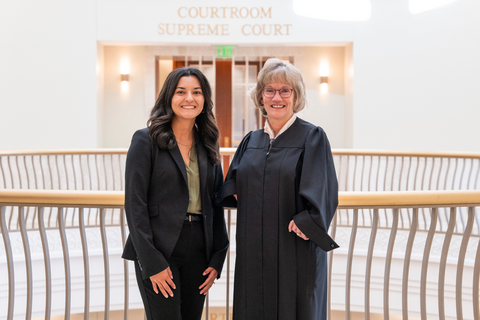
Samantha Savala, Iowa Supreme Court
What kind of work did you do?
“Under Justice [Dana] Oxley’s guidance, I reviewed district court records and appellate briefing, conducted legal research, drafted bench memoranda and first drafts of judicial opinions, assisted with oral argument preparation, and proofread judicial opinions.”
What was the most valuable lesson or skill you gained from your experience?
“Gaining a behind-the-scenes perspective into how the court thinks about the cases before them and getting to learn from Justice Oxley each day. Justice Oxley highly values her relationships with her clerk and wants it to be an engaging, collaborative process each step of the way.”
What are you up to now?
“I am now working at Faegre Drinker as an associate in its Des Moines office.”
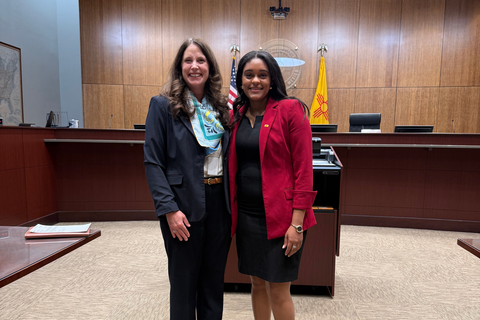
Alexis Jones, New Mexico Court of Appeals
What kind of work are you doing?
“At the New Mexico Court of Appeals under Judge Megan P. Duffy, my job consists entirely of researching and writing. After reading the parties' briefing, I conduct independent research on the relevant law to produce an opinion that resolves the parties' dispute. Because New Mexico is a younger state comparatively, oftentimes I am writing about first impression issues to help develop New Mexico case law. I've mostly worked on civil appeals such as arbitration, workers' compensation, and insurance law, as well as a number of pro se appeals.”
What has been the most valuable lesson or skill you’ve learned so far?
“The most valuable lesson I've learned during my clerkship is to be a careful and skeptical reader. Whether I am reading a party's briefing or researching case law, I've learned to never take a statement or conclusion at face value. It is important to trace a cited case backwards and forwards in time to understand how/why the law has developed a certain way, and the context in which a statement of law was made. This skill has also translated to my writing--I am a more concise legal writer to ensure that I don't break the law, so to speak.”
How has your experience influenced your goals or future plans?
“My experience at the Court of Appeals has exposed me to areas of the law I'd never thought about--particularly as it relates to civil litigation. I have really enjoyed the complexity and ambiguity of civil law and procedure. While I am still passionate about criminal law, it has surprised me to see how advocacy can be used in the civil context and has sparked an interest in practicing both civil and criminal law.”
Jonathan Picado, Central District of California

What kind of work did you do?
“As with most clerkships, the nature of my work centered around writing—whether that be a short minute order to rule on an extension request or a thorough summary judgment order. The Central District of California is a massive and diverse federal district court which greatly influenced the type of cases I worked on. One week I could be working on a trade secret dispute and the next week be drafting an order in a habeas action. The broad range in subject matter always kept a refreshing pace in chambers.”
What was the most valuable lesson or skill you gained from your experience?
“The mentorship and refinement in writing skills are invaluable and will forever influence my legal career. As a law clerk, you are oftentimes working on novel or highly complex legal issues that push you to engage with the writing in a way that inevitably improves your writing. The collaborative nature of the clerkship also provides you with real-time feedback on your writing in a fast-paced environment. You also learn a great deal from observation. Having the opportunity to sit in on countless hearings and study the spectrum of lawyering is a unique component of the clerkship that has greatly influenced my first months in practice.”
What are you up to now?
“I have joined Fried Frank as a litigation associate in Washington, D.C.”
To learn more about clerkship placement from Iowa Law, visit our clerkship webpage.