
Written by: Nic Arp
After five long years of working on one of the most unprecedented cases in modern American military law, three Iowa Law alumni have secured a tenuous measure of justice for their client.
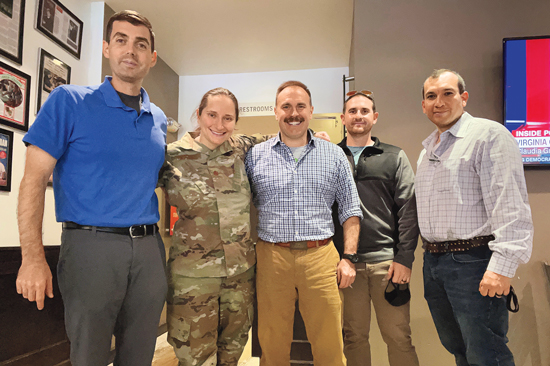
Air Force Judge Advocate General Morgan Engling (09JD), Marine Corps JAG Luke Huisenga (11JD), and Navy JAG Jacob Meusch (10JD) were central to the successful resolution by plea agreement of war crimes charges against Nashwan al-Tamir, a prisoner at Guantanamo Bay detention camp (the government refers to al-Tamir as Abd al-Hadi al-Iraqi). Because of several unusual circumstances, the case attracted considerable interest among the legal and military communities, and it generated a multitude of national and international press articles.
(Engling, Huisenga, and Meusch emphasized that their comments in this article are their own and do not represent the U.S. Department of Defense.)
Military justice in a time of war
By March 2019, when Engling first joined the case, al-Tamir had already been at Guantanamo for 12 years. Al-Tamir had endured a lifetime of war, first as an Iraqi soldier in the brutal Iran-Iraq War of the 1980s. Then—after he fled to Afghanistan to escape conscription into Saddam Hussein’s army for the Persian Gulf War—he fought on the front lines when the United States invaded in 2001. When he was captured in Afghanistan by U.S.-led forces, he was subsequently tortured in a CIA “black site.” Finally, he was transferred to Guantanamo in 2007, in excruciating pain from a debilitating degenerative disease in his spine and imprisoned alongside accused terrorists like those who had allegedly masterminded and executed the 9/11 attacks in New York City and at the Pentagon.
But al-Tamir was not a terrorist. He was a soldier leading troops who were fighting invaders of his country. Afghanistan had become his homeland; he had married and was raising a family there. This distinction between war crimes and terrorism was crucial to al-Tamir’s defense.
“All these military commissions at Gitmo take place in the shadow of the 9/11 case and the war on terror,” Meusch explained. “But Nashwan was charged with more traditional war crimes, things like denying quarter, perfidy, attempted perfidy, and attacking protected property. He was a frontline battlefield commander supervising other fighters, and he was pleading guilty to things that other people did.”
Specifically, al-Tamir pleaded guilty to knowing about and failing to stop his troops’ actions, like firing on a medical helicopter, using a taxicab as a bomb, and destroying Buddha statues in Afghanistan’s Bamiyan Valley. Those are serious charges, but categorically different from terrorism or a conspiracy to commit terrorism, which were the original charges against the defendant.
“In my view, if your country is invaded and you take up arms to defend your homeland, that is not a crime,” Huisenga said. “Distinguishing that from the ‘terrorism’ narrative that envelops all of Gitmo was a challenge.”
“I was definitely intimidated. I thought I had no idea what I was doing. Then more seasoned attorneys, who had been there longer, were like, ‘Yeah, none of us do!’”
—Morgan Engling (09JD)
A case like no other
From a lawyering point of view, the case was unlike anything the three Iowa Law grads had ever envisioned.
For starters, there was an immediate concern about a lack of humane treatment for al-Tamir. His degenerative disk disease had left him often unable to walk. After guards found him incontinent in his cell in 2017, a military team performed five surgeries on him in nine months, which had the effect of worsening his condition. He was unable to get medical attention at a U.S. military hospital, because the law forbids Guantanamo detainees from setting foot on American soil for any reason.
Al-Tamir’s health has continued to suffer, but the defense team made important strides in ensuring that Guantanamo detainees have better access to necessary health care.
“The work the team did on medical standards and medical requirements stands out to me as making a difference,” Huisenga said, “both in exposing what was going on and in adding some enforcement mechanisms to what was supposed to be going on.”
On top of the medical aspect, there was no recent precedent that applied to the merits of the case, given the defense’s underlying distinction between war crimes charges and terrorism charges. The last time the Supreme Court took up the idea of “command responsibility” in the commission of battlefield war crimes was in the wake of World War II.
“This case happened in a statutory framework that was set up post-9/11,” Meusch said. “When 9/11 hit, the government disregarded the whole history of military justice developments after World War II, starting with the Uniform Code of Military Justice. They tried to do something new and different, and our argument was that they did it in new and different ways for reasons inconsistent with due process.”
Finally, there was the sheer amount of work involved in finding and processing evidence and marshaling it to bring the case to a conclusion.
“Morgan led the team in compiling hundreds of thousands of documents over several years,” Meusch noted. “Many were not in English, and some were redacted, and there were all kinds of classification levels. The amount of effort it took just to get a handle on things was immense.”
Engling remembered coming on to the case. “I had a lot of experience as a military defense attorney and civilian public defender,” she said, “but I was definitely intimidated. I thought I had no idea what I was doing. Then more seasoned attorneys, who had been there longer, were like, ‘Yeah, none of us do!’ The government was making it up as they went along and had created this post-9/11 military commission system out of whole cloth.”
She continued, “Everything is hard. There’s the mental and emotional energy of just trying to figure out how to have a meeting with your client. It just seemed so hard on purpose, just to move the needle a little bit. One year in Gitmo time is like one month in a normal trial.”
Engling had never been part of such a vast team. “This was a standing team of investigators and analysts at all classification levels, linguists who were translating things for them to analyze, amazing paralegals,” she said. “Our analysts played a huge role in making sure we understood the documents we were looking at. It was like managing a small law firm.”
By May 2022, supported by Engling’s team’s research and analysis, Meusch and the lead civilian defense counsel, Susan Hensler, had hammered out a first-of-its-kind plea deal with the prosecutors. According to a mutually agreed-upon “stipulation of facts,” al-Tamir would plead guilty to traditional war crimes and the government would drop its terrorism charge. The defendant would serve out his time—10 years instead of up to 30—in a third country, with the clock starting as of the signing of the plea deal. Al-Tamir’s 16 years at Guantanamo and months in a CIA “black site” would not count toward his time served.
Then it was up to Huisenga to bring it all home at a sentencing hearing in December 2024. “The plea deal itself was the big victory,” Huisenga said. “It was an honor to be the person who parachuted into the team last and get the opportunity to take all the years of work that everyone had done and try to combine it into one message and communicate that message to the military members of the jury.”
In June 2024, al-Tamir was finally sentenced according to the terms of the plea agreement. During his trial, the public got its first glimpse of an actual CIA “black site” through photographs of the cell where he was tortured. Though, as Meusch has pointed out, al-Tamir has been imprisoned since before the iPhone came out, he is still in Guantanamo, with no third country yet determined to take him in while he serves out his time.
The Iowa Law factor
Engling, Meusch, and Huisenga had one unique advantage as they worked through this monumental case: their shared experience at Iowa Law.
“The trust between counsel was such a huge part, having come from the same place,” Meusch said. They attributed their success in part to the core legal knowledge and values they gained at Iowa.
“Nothing can prepare you to be defense counsel at Gitmo,” Meusch said. “You’re expected to do things that you can’t anticipate.”
Engling agreed. “There was no primer for my being defense counsel at Gitmo, but there was plenty that was a primer for me to be the person who would raise my hand to be defense counsel in Gitmo,” she said. “Iowa Law had a huge role in that. My 3L externship was at Legal Aid. I was exposed to indigent client work right out of the gate. It taught me a lot about who gets attention from the legal system and who does not.”
All three discussed the impact of Iowa professors who taught them the basics of law, people like Professors Emeriti James Tomkovicz and John-Mark Stensvaag.
“Every single day, I used the stuff that they taught me,” Meusch said. “This case required going back to first principles, things you don’t really use much in day-to-day criminal defense, like going back to initial Supreme Court rulings where precedents were set. I relied on what I learned at Iowa Law every day.”
Engling, whose team—including Meusch—traveled the world during the exhaustive research effort, added, “I can still hear [Professor Stensvaag’s] voice talking about the rules of evidence. And Iowa has a fantastic Law Library. I wrote for the Iowa Law Review. I took all the research classes I could. I had to re-exercise that muscle on this case.”
Through their tenacity and commitment, Engling, Meusch, and Huisenga used their Iowa Law education to forge meaningful change in American military justice standards. They were zealous advocates for their client. And after nearly two decades at Guantanamo, Nashwan al-Tamir has finally found a measure of justice.