
Written by: Blake Etringer
Siduri Beckman (25JD) is taking her clerkship role above and beyond to promote civic education for high school students in South Dakota.
Beckman, a native of Philadelphia, immersed herself in nearly every corner of Iowa Law during her time as a student. From serving as senior articles editor on the Iowa Law Review to participating in the Federal Criminal Defense Clinic, competing on the National Moot Court Team, and leading the Iowa Prison Writing Project, she intentionally sought out opportunities to broaden her understanding of the legal profession.
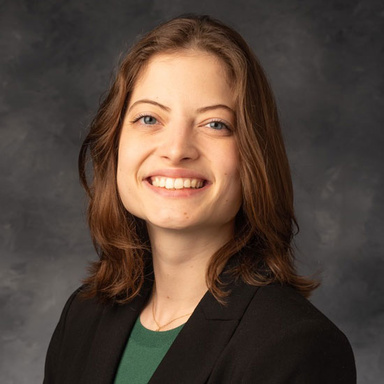
That desire for wide-ranging legal exposure ultimately led her to pursue a judicial clerkship after graduation with Chief Judge Roberto Lange of the U.S. District Court for the District of South Dakota. Her responsibilities range from conducting legal research and drafting opinions to observing hearings and trials alongside the judge.
For Beckman, the experience has provided not only hands-on legal training but also meaningful mentorship. She credits Iowa Law professor Alison K. Guernsey for encouraging her to pursue a clerkship and specifically recommending that she apply to work for Judge Lange.
“I feel like I've grown so much working for him,” Beckman said. “Not just in my writing, but in how I approach legal issues and think about the role of courts and lawyers in our society.”
The admiration is mutual.
“Siduri has been outstanding,” Lange said. “The University of Iowa College of Law prepared her well for the clerkship. She has performed extraordinarily well and will be an excellent lawyer. She already is an excellent lawyer.”
Creating an immersive courtroom experience
One of the most unique aspects of Beckman’s clerkship has been helping create an innovative mock trial program for visiting high school students.
The idea emerged when Judge Lange’s chambers were preparing for students to visit the federal courthouse in Sioux Falls. After reviewing the existing educational materials, Lange felt many of the available mock trail experiences were too passive and did not fully engage the students.
Instead, Lange, Beckman, and the court's other law clerks sought to create a new courtroom simulation from scratch that would fully engage students in the judicial process.
Finding inspiration in contemporary debates surrounding free speech and civic discourse, they developed a fictional case involving a school district's ban on political messages displayed on student clothing. The scenario, loosely modeled on the landmark Supreme Court case Tinker v. Des Moines, asks students to grapple with difficult questions about the First Amendment, student speech, and the limits of school authority.
As Lange began outlining the concept, Beckman immediately started turning ideas into a workable trial.
“Judge Lange started talking through the fact pattern and witness testimony, and I grabbed a legal pad and started writing everything down,” Beckman said.
Within days, the team had developed witness scripts, exhibits, jury instructions, and courtroom procedures. They even ordered custom T-shirts to serve as evidence in the case and conducted practice runs inside the courtroom to refine the experience.

The result is a fully immersive simulation in which students assume the roles of attorneys, witnesses, jurors, court staff, and even judges. Rather than simply observing, students actively participate in every stage of the trial process.
“We wanted students to see how these constitutional questions actually play out in real life,” Beckman said. “I think that it’s really important for teaching these soon-to-be participants in our political society how the law works in practice and how it changes.”
Throughout the exercise, students confront competing viewpoints, evaluate testimony, and ultimately decide the outcome for themselves.
“What they've really gotten to see is how human law is,” Beckman said. “It's all these different people having interactions and creating big questions for us to answer as a society.”
After the mock trial concludes, the experience continues with a simulated appellate argument before Lange and other federal judges, allowing students to see how legal disputes move through the levels of the judicial system.
The program has already been introduced to students from communities across South Dakota and has received overwhelmingly positive feedback, as demonstrated in this video created by a group of local students about their experience. Lange has also shared the materials with judicial education organizations for possible use by courts around the country.
“We've found it to be a really rewarding experience,” Lange said. “The students rise to the challenge, and it's exciting to watch them engage with these issues.”
The mock trial program is just one example of Beckman's efforts to make the law more accessible. She also developed a week-long orientation course for rising 2Ls interning with the District of South Dakota. The program gives students a foundation in federal courts, criminal procedure, and civil procedure, helping them engage more deeply with the work they observe throughout the summer.
Advice for future clerks
As Beckman prepares for her next clerkship with Judge Jane Kelly of the U.S. Court of Appeals for the Eighth Circuit, she encourages Iowa Law students to seek opportunities that push them outside their comfort zones.
“I really tried to stretch myself and be exposed to different areas of law,” she said. “Take a wide range of classes, seek out advocacy opportunities, and get into court whenever you can.”
Most importantly, she emphasizes the value of good mentorship, which is something she experienced firsthand at Iowa Law and continues to benefit from today.
“The more that you can seek out mentorship, the better,” Beckman said. “That's what makes these experiences so rewarding.”
For Lange, that willingness to learn is exactly what makes a great clerk.
“I want someone who is academically strong, writes well, and has a service-oriented mindset,” he said. “But I also want someone who is eager to learn and contributes positively to chambers.”
Beckman's journey from Iowa Law student to federal judicial clerk demonstrates the impact those qualities can have—not only on a legal career, but also on the communities that lawyers serve. Through her work with Judge Lange, she is bettering the local community by helping the next generation understand the Constitution, the courts, and their role in a democratic society.