
Written by: Dan Fost
Caitlin Clark is not the only one winning competitions and putting the University of Iowa on the national map. Iowa Law School’s Moot Court teams and its sports law students have also brought home hardware for the Hawkeyes.

While Iowa’s Moot Court teams have had long-standing success—and continue to excel under the leadership of Professor Mary Ksobiech (00JD), earning accolades year after year—the Sports Law Program, under Professor Dan Matheson, has rapidly emerged as a standout area, providing students with innovative opportunities.
Together, these accomplishments underscore Iowa Law’s commitment to excellence, innovation, and creating new pathways for student success. Both programs build on Iowa’s well-established reputation as The Writing Law School, with the written word playing a major role in their competitive success.
In the National Moot Court Competition, Iowa students were recognized for the best brief in the region. Last year’s team produced the second-best brief in the nation. Ksobiech said Iowa is one of only two schools to advance to the national competition in New York for the past five years in a row.
“Getting to the point where we could research and write a legal brief was only possible because we had such exceptional writing professors at Iowa Law,” said Mike Hegarty (24JD), a member of that team who now works as an associate general counsel with the New York State Assembly. “The law school has put a real emphasis on writing as an important part of the legal education, and I can’t think of a faculty member who embodies that more than Professor Mary Ksobiech.”
Triumphant return to Iowa
Ksobiech graduated from Iowa Law in 2000, and from 2006 to 2020 taught at the University of Alabama Law School, where she helped the Crimson Tide’s Moot Court team win a national championship. “You have to have everything go exactly right, and sometimes the magic happens,” Ksobiech said.

Ksobiech returned to her alma mater, where she is one of seven dedicated writing professors at the law school. In this year’s competition, Iowa faced Boston University.
Iowa’s commitment to Moot Court has its roots in a century-old tradition at the law school, in which the Iowa Supreme Court travels to Iowa City and hears both actual cases and student-argued Moot Court cases.
“It is such an honor for the students to get to do those arguments that it really drives the interest in the overall program,” Ksobiech said.
To have a chance at representing Iowa in the Moot Court competitions, students must pass several hurdles. They have to take courses all three years of law school, including a first-year writing course and appellate law courses in the second year. The top advocates from Appellate Advocacy I are invited to take Appellate Advocacy II in the second semester, and the top students from that course form the Moot Court teams that compete in the third year.
Hegarty, who also served on the Moot Court board, said he could not do his job without the experience.
“This job requires me to conduct research quickly and efficiently on a brief of issues that’s impossible to count,” he said.
Hegarty’s team argued a complicated case in which a mixed martial arts celebrity tweeted about a cryptocurrency while on the U.S.-Canada border.
In Moot Court, advocates have to argue both sides of the case in different rounds.
“When you are writing a brief, you have to write so persuasively that you believe it is the correct answer,” Hegarty said. “Once you write that brief, it’s difficult to pull yourself out of that mentality and convince yourself that it is hogwash. Moot Court gets you there. It made me a stronger researcher and stronger writer.”
Jennifer Schrauth (22JD) said Moot Court “taught me a lot of things that you can’t learn in your doctrinal classes. It taught me skills that I need in my practice that I could not get elsewhere.”
Those skills range from time management to speaking clearly, without “ums” breaking up arguments.
“You have to make good eye contact,” Schrauth said. “You have to think quickly on your feet and not back yourself into a corner with the court.”
Schrauth is now an assistant U.S. attorney in the Northern District of Texas.
“Without that program, I wouldn’t be doing as well as I am in my practice,” she said.
Sports Law on a winning streak
When Karin Nelsen (93JD) and Logan Kutcher (15JD) attended Iowa Law, the school did not offer a sports law program. That has not proven any obstacle to their successful careers in the field—Nelsen is now the general counsel for the NFL’s Minnesota Vikings, and Kutcher is assistant general counsel for Major League Soccer’s Los Angeles Football Club.
They each took very different routes to their current posts. Nelsen rose through the ranks at the multinational food corporation Cargill, Inc., the largest privately held company in the U.S., where the Minnesota native was general counsel for North America until she received the “once-in-a-lifetime opportunity” to lead the Vikings’ legal operations.
Kutcher, a former soccer player himself, knew he wanted to work in sports law and was active with Iowa Law’s Sports Law Society. He networked aggressively, worked for a while at a St. Louis firm that represented NBA superstar Jayson Tatum, and then—after taking two jobs outside of sports—had the chance to move to Los Angeles and continue pursuing his dream.
“The Los Angeles Football Club is the highest-valued MLS team by both Forbes and Sportico,” Kutcher said. “It’s a $1 billion company. Imagine having just two attorneys—me and one other guy.”
While Kutcher said his Iowa legal education prepared him well for a job in which he must perform a wide range of duties—from contract negotiation to intellectual property—there is no question the school now has a much more robust offering for anyone considering a career in sports law.
That’s thanks to Dan Matheson, who had an impressive career in sports law before returning to his hometown of Iowa City in 2011, first as an undergraduate lecturer and ultimately as director of the Sport and Recreation Management degree program and as adjunct faculty at the law school.
Matheson owns four World Series rings, tokens of his time as director of baseball operations for the New York Yankees in the 1990s. He also served as associate director of enforcement for the NCAA.
At Iowa, Matheson brings a commitment to experiential learning.
“I like putting students into scenarios where they have to role-play and apply skills as if they were practicing in the real world,” he said. For instance, he has students negotiate the Major League Baseball Collective Bargaining Agreement, with each student assigned an alter ego—such as a specific team owner, a specific player, the head of players union, or the MLB commissioner.
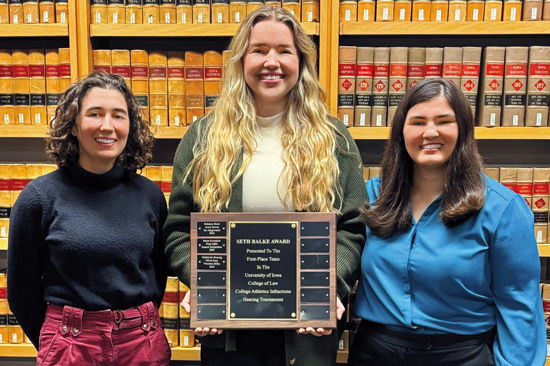
In addition to teaching a semester-long sports law course, Matheson teaches two five-week classes in baseball salary arbitration and the college athletics infraction process.
“There are also competitions that arise out of those two subjects,” he said. “I have been able to develop strong interest among students in competing on teams in those subjects.”
For three years, Iowa has hosted an online National College Athletics Infractions Hearing Competition. This year, 60 students from 13 schools competed, with 38 judges—volunteers from the world of big-time sports— deciding the cases. After winning first place in the writing competition the first two years, an Iowa Law team took second place this year. Iowa Law has also won the runner-up trophy in the mock hearing competition all three years.
Iowa Law teams have also fared well in the Tulane International Baseball Arbitration Competition and the Sports Lawyers Association Student Writing Competition.
“The competitions are a ton of fun,” Matheson said. “They give students a taste of what it’s really like.”
“For all of my courses, whether it’s baseball arbitration, college athletics infractions, or negotiating the MLB CBA, I tell my students, ‘You may never do this actual thing, but always recognize the transferable skills you are developing,’” he said. “‘You are developing and sharpening your oral advocacy skills, your writing skills, your traditional and nontraditional research skills. Some of you may end up having sports as part of your practice, but you don’t have to for this experience to have value to you.’”
“Iowa Law School helped me find a passion and a purpose. The professors cared about their students, laid the foundation, and helped me think in a different way.”
— Karin Nelsen (93JD)
By the same token, even though Karin Nelsen didn’t take sports law classes in her time at Iowa Law, that education prepared her for her job with the Vikings. Nelsen, who grew up on a farm in rural Minnesota, had never met a lawyer before enrolling at Iowa. She wound up chairing the Moot Court team her third year.
“There are lots of journeys one can take if you are interested in a career in sports,” she said. “Iowa Law helped me find a passion and a purpose. The professors cared about their students, laid the foundation, and helped me think in a different way. They helped me be a good writer and try new things.”
Similarly, Kutcher now finds himself doing many things he has never done before at LAFC—“ticketing, marketing, IT, accounting, insurance. When your boss says, ‘Figure it out,’ you have to figure it out.”
He has had to learn joint venture agreements, as LAFC now owns teams in Austria, Switzerland, and Uruguay.
“I have learned way more about trademarks, content licensing, licensing songs to play on social media and in the stadium—you name it,” he said. “It’s a lot of fun. It’s very challenging and intellectually stimulating.”
Other Iowa Law alumni work as sports agents, as general counsel for the Los Angeles Dodgers, for the NCAA, and in other major sports roles, Matheson said. Matheson has even had his students help Iowa’s student-athletes develop their own personal brands as part of the NCAA’s new Name, Image, and Likeness (NIL) regime.
“This is a perfect campus to study the subject,” he said. “We have so much inspiration around us.”